Unlock the Editor’s Digest for free
Roula Khalaf, Editor of the FT, selects her favourite stories in this weekly newsletter.
Volkswagen has set its sights on becoming the “European champion” in self-driving vehicles as carmakers fight to survive a technology race that has been dominated by US rivals Waymo and Tesla.
The German carmaker plans to launch autonomous taxis later this year in Los Angeles with Uber in what is set to become one of the most ambitious efforts by European legacy carmakers to find a new source of revenue in autonomous driving.
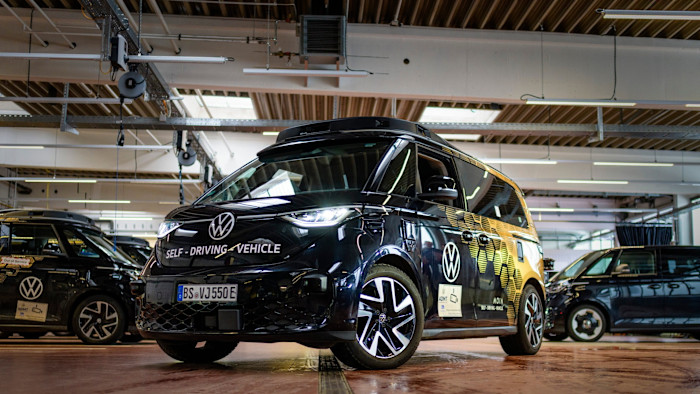
The carmaker’s robotaxi unit, MOIA, has 100 test vehicles on the road in Germany, Norway and the US, of which 30 are in Hamburg. MOIA is in talks with cities in Europe where its service will be rolled out next year after its LA launch, and is aiming to have 100,000 vehicles on the road by 2033.
Christian Senger, the head of Volkswagen’s autonomous driving division, said the carmaker wanted to be a step ahead of its legacy rivals.
“There is a tendency for the market to be an oligopoly where only a few large players will be the most advanced,” he said. “There can be no other ambition from us that MOIA is the European champion.”
Volkswagen’s business model for its autonomous vans is built around a package to local transport operators that would include services such as leasing of vehicles, their maintenance and training to use its fleet management software. That contrasts with other existing tie-ups between carmakers and ride-hailing groups where the revenue comes mainly from providing only the vehicles.
In line with Waymo’s approach, VW’s fleet of specialised ID. Buzz electric camper vans rely on an array of cameras and sensors. But unlike Waymo or Tesla, which have proprietary autonomous technology, the “brains” for VW’s vehicles are from Israeli start-up Mobileye.
Senger said the group was betting on autonomous driving to take off in the commercial vehicle sector with potential annual revenues in excess of €10bn within the next seven years.
“This is an opportunity not to miss” for Volkswagen, he said, predicting the US and European markets for autonomous driving services would be worth €350bn-€450bn by 2035.
Many legacy carmakers have struggled to maintain the heavy investments required to develop fully autonomous technology because of the lack of resources and engineers with software skills.
Among European companies, Volkswagen’s was the “only truly relevant competitor in the robotaxi race that has a chance of achieving a relatively broad market rollout”, said Stefan Bratzel, head of the Center of Automotive Management.
In Europe’s fragmented and highly regulated market, Volkswagen’s local knowhow and partnership model could be an advantage, “especially if you want to integrate robo-shuttles into public transport systems”, he said, although he added the more players VW had to co-ordinate the more complex and costly the process became.
VW will be entering a market where Waymo has established itself as a leader in robotaxis, having recorded more than 125mn fully autonomous miles on US roads with few related safety incidents.
Tesla has staked its future on AI and autonomy, while Chinese carmakers are also investing in self-driving technology. Elon Musk’s group last year started its robotaxi service in Austin, but concerns have persisted about the safety of the vehicles which lack laser-detecting Lidar sensors.
Volkswagen’s project clearly lags behind Waymo’s lead in terms of distance driven, with its test vehicles having covered a total of only 1mn kilometres (620,000 miles).
But the German carmaker thinks its knowledge of the European market and the mapping data collected by VW’s existing passenger vehicle fleet offers an advantage over US rivals.
While MOIA is required to have someone in the driver’s seat, a recent test drive in Hamburg showed the autonomous vehicle’s ability to navigate snowy conditions without human intervention.
Volkswagen’s early experience in difficult road conditions was an edge on rivals who have deployed their cars in the sunny US south-west, said Senger. “We need to test where it’s very challenging . . . we will deploy where it’s easy.”
Legacy carmakers have struggled to keep pace with both the advances made by tech giants in autonomous driving and the heavy investments that are required to turn the technology into a scalable business.

Few companies are actually developing the core self-driving technology themselves while many have chosen to form technology partnerships.
Some analysts question VW’s self-driving vehicle strategy. UBS analyst Patrick Hummel cautioned legacy carmakers were unlikely to play “a significant role” in the autonomous driving space because they do not control the “brain” of the technology.
The risk was that carmakers would be providing commodity hardware at “razor-blade thin” margins while technology groups chose those able to assemble vehicles in low-cost countries, he added.
VW’s latest tie-up with Uber in the US came after Argo AI, a self-driving vehicle group jointly backed by the German carmaker and Ford, abruptly shut down in late 2022.
German rival Mercedes-Benz has also partnered with China’s Momenta and taxi group Lumo to launch a “luxury robotaxi service” in Abu Dhabi. It is also working with Uber and Nvidia to develop premium-class robotaxis.
Mercedes-Benz and BMW have at the same time scaled back their plans to introduce more advanced self-driving technology, while Mercedes has newly invested in UK self-driving start-up Wayve.
In order to maintain investment flows into autonomous technology, Volkswagen said it was prepared to open the ownership structure of its autonomous driving unit as it tries to trim the group’s day-to-day spending and costs.
There were likely to be unseen costs which were necessary for expanding, which VW might not be willing to fund on its own, Senger said, adding: “If you are not able to scale, you will never get to the profits.”