During the second world war, the town of Swindon played its part by manufacturing Spitfire fighter planes, repurposing skilled labourers from the carriage works that made trains for Isambard Kingdom Brunel’s Great Western Railway.
Now, more than 75 years after the last Spitfire rolled off the production lines, Swindon is making a return to cutting-edge combat aviation technology with a cluster of some of the world’s most advanced drone makers.
But it is the anticipated arrival of a cavernous Ministry of Defence drone-testing facility that has the potential to make Swindon a European centre for what is now a crucial defence technology.
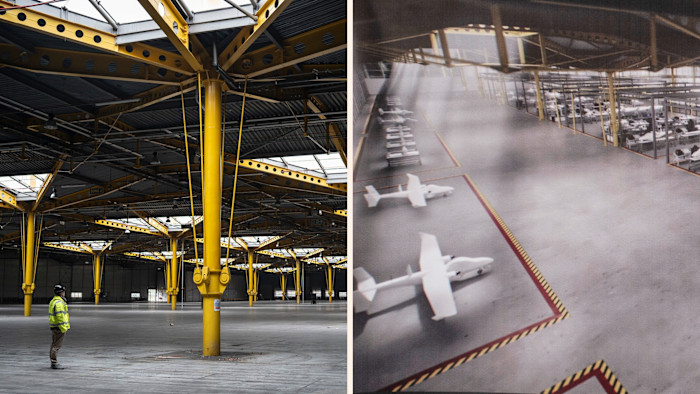
The facility, expected by industry insiders to be announced next month, sits on the same 360-acre site that once housed the Spitfire factories and then the Honda car plant that closed in 2021.
While exact details remain classified, insiders say the 525,000 sq ft indoor training facility covering the equivalent of eight football pitches will be used to stress-test drone technology that is now rapidly transforming modern warfare.
In a sign of the scale of ambition, the MoD facility, if confirmed, would be four times the size of Nato’s small tactical drone centre in Latvia, giving Swindon potentially European-level significance as a drone technology centre.
The MoD facility would provide the lodestar for a rapidly expanding group of drone start-ups that have recently moved to Swindon.
Leading companies investing in the area include German-owned Stark, British start-up Flyby Technology and Portugal-based Tekever that will open a 200,000 sq ft manufacturing facility in Swindon this summer as part of a £400mn investment in the UK over five years.
Swindon is seen as a favourable location, close to the university centres of Oxford and Reading, and 80 miles west of London along the “M4 corridor” that runs to Bristol, which is home to the MoD’s Abbey Wood procurement complex, sometimes called the “UK’s Pentagon”.
The town was a magnet for foreign investment in the 1970s and 1980s, but more recently has fallen on hard times. Now it is building an industrial revival based around its proximity to an emerging cluster of defence and technology companies.

Local MP Will Stone, who as Labour’s “business champion” for defence technology has been instrumental in attracting drone companies to the area, said the arrival of Tekever and others opened the door for Swindon to become a hub for global exports, not just hoped for MoD contracts.
“We want Swindon to become a manufacturing and testing hub for global exporters and play its part in supporting the UK’s sovereign defence capability,” he told the FT on a tour of his constituency.
The MoD’s hub is only part of the redevelopment of the former Honda site by Panattoni, the US-owned logistics and warehousing provider that is delivering a £925mn transformation of the site that will eventually host 7.2mn sq ft of industrial space.

Industry executives in Swindon are hopeful that the new drone investments will deliver broader benefits beyond defence.
“I see defence merely as an opening and an accelerator for a much bigger opportunity,” said Sir Iain Gray, the former managing director of Airbus UK who is now championing economic revitalisation of the region as part of Futures West group.
The UK, along with other European countries, has promised to raise defence spending in the face of Russian aggression and amid concerns that the US will no longer help to defend Europe.
Labour has said core defence spending will rise to 3.5 per cent of GDP by 2035, with ministers promising a “defence dividend” that will help to stimulate economic growth.
The government has announced plans to buy up to 8,000 drones in 2026 as part of a drive to interact more closely with industry and academia in the rapidly evolving world of “unmanned aircraft systems” or UAS.
Yet despite the promises, industry concerns are rife that the government’s rhetoric is not matched by reality, with the UK’s Armed Forces warning of a £28bn funding shortfall over the next decade if they are to follow through on plans to modernise the military. A Defence Investment Plan, detailing which type of equipment would be bought, has been repeatedly delayed.
Mike Armstrong, the UK managing director of Stark, which currently has MoD contracts, said that the industry was aware of a “say-do gap” between commitments to spend more on defence and the delivery of that investment.

UK government defence contracts were essential to anchor the Swindon drone cluster, delivering both economies of scale for producers and credibility for British drone exports, he said.
“As a nation, closing that ‘say-do gap’ is essential. We need to commit to scaled production of weapons systems that sends a clear signal to our adversaries — that’s what stops the next conflict from happening,” he added.
The MoD said last year’s Strategic Defence Review was “clear that we must learn the lessons of the war in Ukraine, which is why we’re investing in drone and counter-drone systems and backing the defence industry to support drone development in the UK”.
The government, it added, was “making defence an engine for growth across the country, strengthening both our economy and national security”.

At the site of the old Honda factory the wartime runway that was once used to dispatch newly produced Spitfires and then to test drive cars has now been removed as part of the redevelopment.
However, 10 miles to the south, outdoor drone flight testing facilities for the industry are being developed at the 550-acre former RAF Wroughton, which still has the wartime runway and aircraft hangars where planes damaged in raids over Germany were repaired.
The site is also home to the national collection of the Science Museum, a vast repository that includes the designs for Barnes Wallis’s bouncing bombs that were used in the Dambusters raid of May 1943.
Matt Moore, the Wroughton site’s director, said that a change in planning permission had opened the way for it to be used in drone flight testing, with several tech companies expressing interest in taking space.
“It feels like we’re bringing the site full circle. We want to utilise it for research and development purposes, including renewable energy, autonomous vehicles and drone tech. We’re bringing back the inventiveness,” he added.

Tekever, which acquired West Wales Airport in July 2025 for testing new drones over the sea, said the company had also obtained permission for factory tests of drones at a site near its Swindon manufacturing centre.
Scott McClelland, deputy director of Tekever, added that the availability of skilled labour was another part of Swindon’s attraction, with engineers and technicians who worked on Honda’s production lines highly suited to work in drone manufacturing, just as their forebears in the GWR carriage works had once turned their hands to making Spitfires.
“Why Swindon? It is the combination of its industrial heritage, connectivity to London and other MoD sites and a ready skills base — automotive production line skills are highly transferable to this sector,” McClelland added.
Jon Parker, the founder of combat drone manufacturer Flyby Technology which recently relocated back from Turkey to the UK, said that Swindon was fast becoming a “one stop shop” for the drone industry.
Flyby’s technology, which includes the ability to fire supersonic missiles from a hovering drone, has been selected as part of an MoD programme to evaluate how drones can be used to protect soldiers in the field.
Parker added that Flyby was partnering with US arms manufacturer CheyTac with a view to setting up parallel production in Florida and Texas for the US market.
“That’s the impact of what is being done in Swindon. We were originally focused on Leeds, which is an AI hub, because a lot of what we do is about autonomy, but we’ve switched to Swindon because of the joined-up nature of it. It’s a one-stop shop,” he said.