Stay informed with free updates
Simply sign up to the Oil & Gas industry myFT Digest — delivered directly to your inbox.
Greece has signed its first offshore gas exploration agreement in four decades, in a landmark deal led by ExxonMobil that signalled growing Washington interest in the eastern Mediterranean.
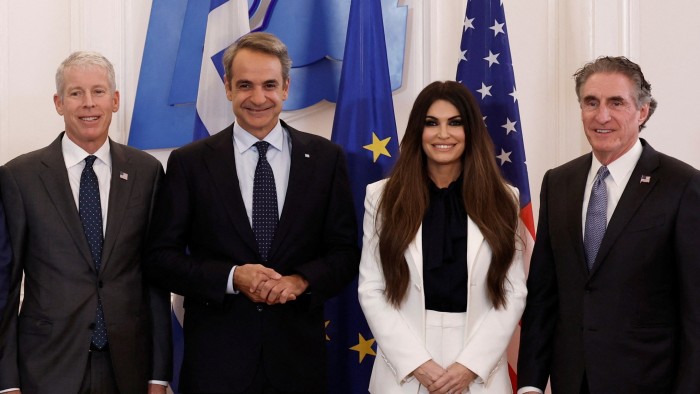
Top US officials, energy secretary Chris Wright and secretary of the interior Doug Burgum, met Greek Prime Minister Kyriakos Mitsotakis in Athens at an energy co-operation summit this week ahead of the signing.
The new drilling deal involving ExxonMobil, Energean and HelleniQ Energy allows exploration in the Ionian Sea, about 30km west of Corfu, and is expected to begin by the end of 2026. ExxonMobil will hold a 60 per cent stake and operate the venture if the tests prove successful. The reserve is estimated to contain as much as 200bn cubic metres of gas.
The unusually high-profile US delegation highlights its deepening involvement in Greek energy policy. It also comes after Greece joined with Cyprus to break the EU bloc vote by abstaining in a UN ballot involving a shipping emissions levy that was fiercely opposed by the US.
Greece is also seeking to boost imports of US liquefied natural gas for re-export through the so-called vertical corridor, linking Greece to Ukraine via Bulgaria, Romania and Hungary. Greece’s role in gas transport is likely to grow further if the EU moves towards a complete ban on Russian supplies.
Wright said Greece was the “perfect entry point” into Europe for US LNG, as it diverted its energy supply from Russian gas. “We have the opportunity to replace every drop of Russian gas, we have a lot of gas.”
Mitsotakis has recently signalled a recalibration of Greece’s energy agenda. Writing in the Financial Times last month, he said that “the green transition cannot be an end in itself”.
The participation of a US oil major in the drilling deal further underlines Washington’s strategic footprint in the eastern Mediterranean, a region where tensions remain with Turkey, Greece’s historical rival.
ExxonMobil vice-president John Ardill told the FT the Ionian Sea agreement “could open a new chapter in domestic energy security and economic prosperity for the people of Greece”.
Burgum also linked the deal to energy security and national security. “America’s goal is to produce energy we can sell to our friends and allies — so they no longer need to buy from our adversaries,” he said.
But the drilling in the Ionian is expected to spark criticism from environmental campaigners and coincides with the UN climate summit in Brazil, which Mitsotakis will not attend.
Greece is among the countries most affected in Europe by climate change, which has exacerbated fires and drought on the fastest warming continent in the world.
Greek environment and energy minister Stavros Papastavrou described it as “a historic signing” that could “bring technology and capabilities to Greece’s hydrocarbon sector and provide domestic resources for Greece and Europe”.
“It’s a geopolitical upgrade — Greece is becoming an important player on the energy chessboard,” said Constantinos Filis, director of the Institute of Global Affairs at the American College of Greece. “The country is gaining geopolitical weight as Europe intensifies its focus on energy security and reducing dependence on Russia.”
Climate Capital

Where climate change meets business, markets and politics. Explore the FT’s coverage here.
Are you curious about the FT’s environmental sustainability commitments? Find out more about our science-based targets here