Europe’s climate technology start-ups have gained renewed strategic importance as the continent’s leaders react to wider geopolitical change, even as some data appears to show waning appetite for green investments.
Some early stage businesses have taken a hit from a year of upheaval since US President Donald Trump’s return to the White House. But others are emerging stronger. Green start-ups producing core technologies that meet broader economic and industrial demand are benefiting from European efforts to improve defence capabilities and cut reliance on foreign technology and supply chains.
“Climate is no longer a standalone objective. It is interlinked with politics, security, resilience and competitiveness,” says Sebastian Heitmann, co-founder of Extantia Capital, a venture capital firm that invests in climate technologies.
Data suggests 2025 was another turbulent year for climate tech. Funding for Europe’s green start-ups hit its lowest level since 2020, falling by 23 per cent from 2024 levels, according to research company Dealroom, while funding for artificial intelligence infrastructure companies grew five-fold and funding for defence start-ups nearly tripled.
“Back in 2021 and 2022 climate tech was all the hype,” says Michelle Capiod, co-founding partner of Blume Equity, a sustainable investment fund. Since then “the narrative has changed completely”, she adds.
After returning to office last year with a promise to “drill, baby, drill” Trump has slowed domestic renewable energy projects, pulled out of global climate governance and most recently scrapped the legal basis underpinning US climate regulation.
The withdrawal of support from the world’s biggest economy to tackle the climate crisis has left certain business models out in the cold on both sides of the Atlantic.
Companies built around green premium technologies, like green cement and sustainable aviation fuel — which tend to cost more than conventional alternatives — have suffered.
“The appetite to pay more for sustainability is not there,” warns Matthew Blain, investor at Voyager Ventures, a venture capital firm, adding that those who had invested in companies dependent on flagship climate policies of the previous US President Joe Biden had been left “exposed to the political winds changing”.
Companies building capital-intensive first-of-a-kind projects, which require novel manufacturing techniques or produce a new product, are also struggling, Capiod notes. Last year, for example, French start-up Ÿnsect, which farms insects to create protein for animals and humans, filed for insolvency.
Eric Weber, chief executive of start-up accelerator SpinLab, says business models revolving around climate reporting and compliance software for environmental, social and governance (ESG) objectives also look less viable. “Momentum is more with defence and deep tech,” he adds.
Some European green investors and hub leaders say there has simply been a reframing, however, as the sector becomes more established.
“I don’t think [climate tech has] been dropped in the way that the data might suggest,” says James Cole, head of the Cambridge Institute for Sustainable Leadership’s Canopy accelerator.
He points to companies at Canopy that resist easy categorisation — from architectural software start-ups using drones to map home energy efficiency improvements, to those making bio-based food packaging — as evidence that climate considerations are diffusing across sectors rather than disappearing.
Similarly, Blain at Voyager Ventures sees sustainability as “a theme that sits across all sectors”, and says green investments are increasingly being absorbed into adjacent industries — whether that is defence and AI infrastructure or manufacturing and materials science.
This is partly because green technologies such as electric vehicles, heat pumps and batteries offer better profitability on a per-unit basis and are often more efficient than their conventional counterparts, he adds.
Data methods that track climate tech as a standalone category may miss the investment flowing into areas such as manufacturing, energy and critical minerals, Capiod says, if they are not labelled as climate investments.
Lena Thiede, general partner of Planet A Ventures, a venture capital firm specialising in green tech start-ups, suggests the ecosystem is “maturing” as capital moves towards businesses that help solve “systemic challenges in infrastructure, energy and clean industrial systems”.
Many of the technologies Planet A backs “serve broader economic and industrial needs alongside decarbonisation outcomes”, she says, adding there is “political strategic urgency around many core climate technologies”.
Some of this urgency comes as Europe pushes to cut its dependence on the US for defence and reduce its reliance on other technology imports and global supply chains.
In a speech at the World Economic Forum in January, European Commission president Ursula von der Leyen spoke of a “necessity to build a new form of European independence” — noting that consensus around this goal had grown over the past year, due to fraying transatlantic ties and the persistent Russian threat.
Blume Equity’s interest in the energy transition is driven not only by the need for climate action, but by how Europe can be competitive and drive overall sovereignty and security — which requires “cheap, abundant access to energy”, says Capiod.
The intersection between renewable energy and Europe’s push for autonomy has led climate investors to seek tailwinds from the AI boom.
“The world has moved from an energy transition game to an energy addition game due to the hyperscalers,” Heitmann says, referencing AI data centres, which will account for just under 3 per cent of global electricity demand by 2030 according to the International Energy Agency. Over the past year, European governments have pledged tens of billions of dollars of investment to build data centres in a bid to reduce dependence on US-based ones.
With energy needs “ballooning”, there are exciting opportunities for green investors in the AI space, says Capiod. Blain agrees, adding that the requirements for building and powering data centres are “all within the scope of climate tech”.
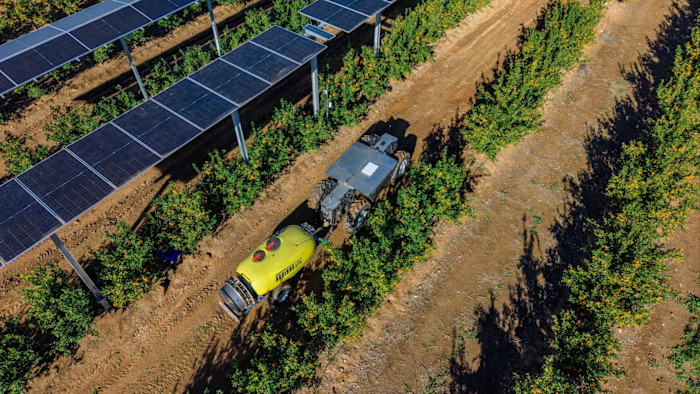
Europe’s push for greater autonomy is also driving interest in dual-use technologies, which have commercial and military applications. Around 80 per cent of Extantia Capital investments have a potential dual-use case, such as Voltrac, a Spanish start-up building autonomous, all-electric vehicles that can be used for agriculture as well as on the battlefield.
Capital is flowing from defence funds towards green start-ups as well. A Nato-backed €1bn venture capital fund lists “energy” and “novel materials and manufacturing” among its focuses, while Voyager Ventures counts In-Q-Tel, the Central Intelligence Agency’s not-for-profit venture arm, as one of its main co-investors over the past 14 months, says Blain.
“The solutions that are climate-friendly happen to deliver on many of our other strategic goals,” Heitmann says. “It’s almost an invisible hand to be honest . . . the climate crisis might be averted by forces which had no intention of averting it.”